.svg&w=32&q=75&dpl=dpl_dAmta2RFvBo4McW13rS5CascQtnM)

.svg&w=32&q=75&dpl=dpl_dAmta2RFvBo4McW13rS5CascQtnM)
Featured Guest
Matthew Fornaro
Episode Notes & Transcript
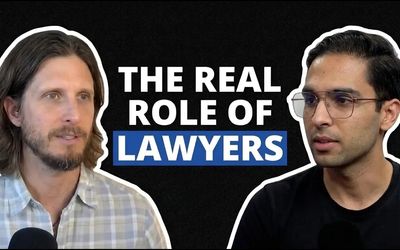
This episode features Matthew Fornaro, a business law attorney who left the corporate "Big Law" world to start his own successful practice. Set in early 2026, the discussion focuses on how artificial intelligence is fundamentally transforming the legal industry.
Timestamps
00:00 - Leaving Big Law: Why Predictable Income Can Be a Trap
02:17 - Do Lawyers Need Formal Business Education to Succeed?
04:38 - Why AI is the Ultimate Force Multiplier in 2026
05:47 - Editing AI Drafts vs. Starting from Scratch: Trust but Verify
08:44 - The Tech Arms Race: Keeping Up with Claude, Clio & Westlaw
13:51 - The "Problem-First" Approach to Choosing Legal Tech Tools
16:08 - $50 AI Website Builders vs. $2,000/mo SEO Agencies
21:42 - Is the Billable Hour Dead? How AI Changes Law Firm Economics
26:15 - Building a Standout Personal Brand on LinkedIn
28:28 - The Niche vs. General Practice Dilemma for New Solos
31:34 - Using Guardrails to Avoid "AI Slop" in Your Marketing
33:24 - Who Owns AI-Generated Code? IP Law for Tech Founders
35:26 - Creating Legal Guardrails Against AI Hallucinations & Liability
36:58 - Why a $50 Online Legal Template Could Bankrupt Your Business
39:03 - The Lazy Mistake That Destroys Small Businesses
40:00 - Got a Cease & Desist? Do These 3 Things Immediately
Full Transcript:
Awais Haq: Welcome back to the show. Today we are diving into business law in 2026, and my guest is Matthew Fornaro, a business law attorney who left a safe Am Law 200 firm 11 years ago to build his own practice, Matthew Fornaro Law. Thanks for coming, and I'm really happy you've joined me today.
Matthew Fornaro: Well, thank you for having me. I'm glad to be here.
Awais Haq: You often talk about the plateau in big firms where the equity buy-in feels like a life sentence, so you chose independence. I've talked to many lawyers in this space who look at predictable income and massive benefits as a golden safety net. Why trade that for the uncertainty of a solo shingle?
Matthew Fornaro: One size doesn't fit all, and what's a good choice for one person isn't necessarily right for another. At that point in my career, I felt the better move was to try doing something on my own rather than being stuck in the machinations of a Big Law firm for the rest of my professional life. While there's an alleged guarantee of income or safety, I think that's somewhat of a misnomer too.
Awais Haq: A lot of people lack business education because they don't study business fundamentals during law school. If a young attorney is listening, do they really need to learn the nuts and bolts before they start, or can they wing it like you did?
Matthew Fornaro: Learn as much as possible as early as possible about how business functions, how to start and run a business, and everything that goes into owning or operating one. Don't wing it. I had to wing it because I didn't know anything, but I got lucky and was fortunate to complete educational programs that helped me. My advice is not to wing it—get as much education and information as possible beforehand.
Awais Haq: Does that education come from experiencing a law firm firsthand, or should they study business as a separate subject?
Matthew Fornaro: You're never going to learn about the business side of a law firm by working at a Big Law firm. The bigger the firm, the less you learn about the actual business of law. At a smaller firm, you'll learn more about the business of law, but it's best to learn from dedicated business education and resources. The ideal time is during college or law school, but otherwise, pursue supplemental education or read books. You definitely won't learn business fundamentals inside a law firm.
Awais Haq: In 2026, we see AI acting as a massive force multiplier. How is AI transforming business law today?
Matthew Fornaro: AI is probably the biggest technology shift to hit all businesses since the internet. It's getting bigger and more invasive over time. In 2026, professionals, business people, and human beings need to be proficient in AI because if you aren't, you will be surpassed by those who are, regardless of your industry.
Awais Haq: While AI can generate a draft in 10 minutes that used to take weeks, there's also the issue of "AI slop". Is it worth using AI when attorneys charging high hourly rates still have to review and fix the generated output?
Matthew Fornaro: AI is just another tool for business professionals and attorneys. Generations ago, legal research required going to a physical law library or reading physical books. Those were supplemented by online research services like Westlaw or Lexis a quarter-century ago. Now, those services are being supplemented by AI.
You must take ownership of the AI. You are ultimately responsible for what goes out, so you need to trust but verify, edit, and ensure the work product is acceptable. People get into trouble when they pass on AI work without due diligence. AI saves the attorney significant time, which ultimately saves the client money by automating brute-force labor. Instead of taking hours, tasks take minutes. Reviewing and verifying AI work takes exponentially less time than doing the entire task without it.
Awais Haq: Platforms like Westlaw, Lexis, and Clio are investing heavily in AI, but new models like Claude's legal tools drop every few weeks. How can lawyers keep up with these rapid technological advancements while actively running a practice?
Matthew Fornaro: It's hard because every industry is in a technological arms race where the stakes keep rising and tools keep improving. As a practitioner, you have to stay aware of what's coming down the road. What you're using today as a "level 2 or 3" tool will soon be replaced by a "level 7, 8, or 10". You shouldn't be married to any single platform, but rather to the concept of implementing better technology into your practice. When something better comes along, evaluate whether to adopt it.
Major platforms like Westlaw, Lexis, and Clio continuously improve and expand their AI programs in response to competitor innovations. Try to keep short-term contracts in case you need to switch platforms, and don't be afraid to use multiple AI systems simultaneously for practice management and business operations. Embrace new tech based on sound business decisions rather than fearing new rollouts.
Awais Haq: Could you explain the "problem-first" approach to tech tools that you've advocated for recently?
Matthew Fornaro: There is an overwhelming flood of AI products and marketing targeting attorneys on Google, social media, and email. Instead of getting distracted by every new program that comes out, focus on your specific operational problem first. Identify your challenge—whether it's case management, legal research, or client interface—and conduct thorough consumer research to find the best solution. Let the problem dictate the product rather than allowing marketing products to dictate your workflow.
Awais Haq: AI can build websites quickly, but search engine optimization, indexing, and geo-targeting require detailed work. Why would an attorney trust a $50 AI tool over a $2,000-a-month SEO agency?
Matthew Fornaro: The $2,000 agency is likely using a version of that $50 AI tool and marking up the price. Quantum leaps in technology have made AI optimization, keyword indexing, and web design tools exceptionally sophisticated. Tasks that previously required paying agencies thousands of dollars can now be handled by AI programs at a fraction of the cost, working continuously without fatigue or missed deadlines. For an attorney or entrepreneur, paying AI a tenth of the price delivers accurate, effective results.
That said, I still retain my website and technical specialist to maintain human oversight, handle hosting, and ensure seamless communication when changes are needed. AI can handle heavy operational lifting, but keeping a human in the loop provides reassurance. Specialized $50-a-month AI web design and SEO platforms deliver high quality that previously cost thousands.
Awais Haq: Will AI eliminate hourly billing and monthly retainers in law firms? If hourly billing is so profitable, why would law firms adopt AI in the first place?
Matthew Fornaro: AI won't kill billable hours or retainers in litigation, but billing models must adjust to reflect increased efficiency. Previously, completing a task might take 10 hours. With technology, you can complete 10 similar tasks in those same 10 hours. If a task now takes one hour instead of 10, you bill the client for one hour. Economically, you maintain revenue by handling a higher volume of matters rather than padding hours or overcharging. You bill less time per individual matter, but handle far more matters overall. That is how law firms should realistically and authentically adapt their business models.
Awais Haq: If AI handles routine tasks, what becomes the primary role of a managing partner or law firm founder?
Matthew Fornaro: The managing partner must reflect on how to implement technology strategically across the practice and business operations. They must establish top-down and bottom-up guidelines to ensure tech adoption is economically feasible for the firm and fair for clients, ensuring billed hours accurately reflect actual work performed.
Awais Haq: Why is building a personal brand on LinkedIn so important for attorneys today?
Matthew Fornaro: Your personal brand is synonymous with your professional identity and the core values you bring to your business. A strong personal brand stands for something specific. For example, my brand focuses on representing small businesses, entrepreneurs, and startups in litigation and transactional matters in Florida and beyond. Prospective clients researching online can easily see what I stand for. If you remain a generic "general practitioner," clients won't have a reason to choose you over a specialist focused on their specific geographic market and legal problem.
Awais Haq: When launching a practice, should an attorney pick a niche immediately, or accept general legal work until they establish a client base?
Matthew Fornaro: It's easier said than done when starting out. When I launched 11 years ago, I took on matters I wouldn't touch today out of financial necessity. However, you should maintain an aspirational focus on your ultimate niche. In the interim, if you must take on cases outside your core area to pay bills, ensure you handle them competently and ethically. If a matter is completely out of your depth, refer it out to a specialist and secure a referral or co-counsel fee rather than risking client outcomes.
Awais Haq: If attorneys use AI to generate social media content, how can they avoid generic "AI slop" and preserve their personal voice?
Matthew Fornaro: Modern AI tools allow you to configure guardrails and settings that keep content innovative, practice-specific, and geographically tailored. Most importantly, review everything before publishing to ensure it authentically reflects your brand rather than posting generic legal slogans. Use creative formats like video clips or meme generators to capture attention while conveying real value.
Awais Haq: In 2026, if a startup founder uses offshore developers or AI to write initial software code, how can they ensure they actually own the intellectual property during investor due diligence?
Matthew Fornaro: IP ownership surrounding AI-generated content remains unsettled legally because copyright frameworks were designed for human creators, not artificial intelligence. To protect your business, execute clear agreements—such as work-for-hire contracts—stating that you unequivocally own all rights to any code or content generated by AI, contractors, or offshore developers.
Awais Haq: If an AI tool hallucinates and costs a client money, what terms of use should founders include in 2026 to stay out of court?
Matthew Fornaro: Include alternative dispute resolution (ADR) provisions requiring arbitration or mediation rather than open court litigation. Operationally, implement strict internal controls requiring human review and sign-off on AI-generated outputs before client delivery to verify accuracy and prevent hallucinations.
Awais Haq: When does a cheap $50 internet contract template turn into a $50,000 legal liability for a small business?
Matthew Fornaro: A cheap template can become a massive liability at any moment. Downloading a generic template means you don't know whether it's legally binding, includes proper dispute resolution, or covers attorney fees for your jurisdiction. Relying on a $50 template is a risky roll of the dice. Investing in due diligence upfront with a licensed attorney costs exponentially less than litigating a defective contract in court later.
Awais Haq: What is one common mistake that can bankrupt a small business?
Matthew Fornaro: Failing to do proper due diligence when launching. Business owners often fail to create a written business plan, neglect consulting attorneys and accountants to select the proper legal entity, fail to draft governing operating agreements, and lack a trusted advisory team of attorneys, bankers, and accountants.
Awais Haq: If a business owner receives a cease-and-desist letter, what three steps should they take before responding?
Matthew Fornaro: First, take it seriously—don't delete it or throw it away. Second, consult an attorney immediately to evaluate the letter's legal validity. Third, formulate a calculated, well-thought-out response with your legal counsel rather than sending a panicked or emotional email.
Awais Haq: Where can listeners find your legal resources for business?
Matthew Fornaro: Visit my website at fornarolegal.com. I have links to my social media, blogs, white papers, videos, e-books, and contact information.
Awais Haq: Thanks for being so candid today, Matthew. If you're a founder, check your IP assignments; if you're a lawyer, check your AI drafts. See you next week!
About the Guest
Matthew Fornaro has been a business law attorney serving South Florida, including Coral Springs and Parkland, since 2003. Prior to starting his own law firm, he was an attorney at a 300+ attorney civil practice law firm that served local, national, and international clients, and was also an attorney at a prestigious national law firm. Matthew practices complex commercial litigation, including contract disputes.
Matthew, a member of the Florida Bar and District of Columbia Bar, also practices construction law, intellectual property law, homeowner and condominium association representation, and drafts and revises of business documents, including the formation of business organizations.
Matthew assists new business owners in choosing and drafting all legally required documents. Matthew is involved in mentoring new attorneys, as both a graduate and instructor of the Kaufman Foundation’s FastTrac NewVenture Program, presented by the Broward County Office of Economic and Small Business Development and the City of Hollywood, as well as a graduate and instructor for the Florida State University College of Business Jim Moran Institute for Global Entrepreneurship Small Business Executive Program.
As a small business owner himself, Matthew is proud of his representation of businesses in our community and is also available to assist in all transactional and litigation needs.
About the Host

Awais Haq
Legal Tech Consultant & The Lawyer Podcast Host
From civil engineering to revolutionizing legal tech, I’m a problem-solver driven by impact. Disillusioned by industry malpractice, I pivoted to build tech solutions that matter - first scaling an online tutoring marketplace to $800K ARR, then founding Time Technologies LLC in Nov 2024. With 19+ projects across edtech, government security, and AI, I now focus on empowering small to mid-sized law firms by slashing admin burdens.


Was this episode helpful?
Your feedback helps us improve our content.
Share this Podcast
0 Comments
or to leave a comment