.svg&w=32&q=75&dpl=dpl_dAmta2RFvBo4McW13rS5CascQtnM)

.svg&w=32&q=75&dpl=dpl_dAmta2RFvBo4McW13rS5CascQtnM)
Featured Guest
Jane Muir
Episode Notes & Transcript
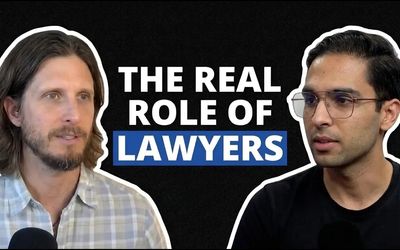
Is it better to bootstrap your way to success or take on early investors? In this episode, Awais Haq sits down with Jane Muir, Managing Shareholder of J. Muir & Associates and former President of the Miami-Dade Bar Association.
Jane shares her "trench-tested" advice on why she favors bootstrapping, how to protect your Legal Tech startup from hallucinations/liability, and the secret to scaling a niche law firm using the "Profit First" mentality.Whether you are a Legal Tech founder or a firm owner looking to automate your workflow, this conversation is packed with actionable insights on delegation, decision trees, and why "the riches are in the niches".
Timestamps:
00:00 - Introduction: Meet Jane Muir, a multi-award-winning litigator in Coral Gables.
01:32 - The Bootstrapping Advantage: Why testing concepts with limited resources makes your business stronger.
04:40 - Equity & Dilution: Lessons from Spanx vs. StubHub—why early investment can cost you your exit.
07:42 - Legal Tech Protection: How to use "Click Wrap" agreements to limit liability in the age of AI.
11:56 - Profit First for Law Firms: Why you must set aside 10% for administration and bookkeeping.
15:11 - The 10,000-Hour Rule: Why technicians shouldn't try to be their own lawyers.
22:47 - Mastering Delegation: Overcoming the "E-Myth" trap and the fear of the Bar.
28:34 - Workflow Automation: Building decision trees for intake and client management.
35:28 - The Cost of Manual Processes: Why missing a follow-up link is a direct loss of revenue.
47:50 - The Riches are in the Niches: Why Jane refuses to do Family Law to protect her referral network.
52:16 - Authority Marketing: Using LinkedIn and video to find clients who share your values.
56:44 - Final Advice: "Get knocked down six times, stand up seven".
Full Transcript:
Awais: Today's guest is very special. On her website, the headline reads: "Your business, your livelihood, our passion." Instead of saying "I'm the best lawyer in Miami," that framing is unique. Jane Marie Muir is the managing shareholder of J. Muir & Associates, a multi-award-winning firm in Coral Gables. Beyond her success in complex commercial litigation, Jane has served as president of both the Coral Gables and Miami-Dade Bar Associations, and is frequently court-appointed as a receiver. Welcome to the show, Jane.
Jane Muir: Thanks, Awais. Thanks for having me.
Awais: I help legal tech startups write code. Some startups look for seed funding while others bootstrap. What should founders consider in these two conditions?
Jane Muir: I'm a bootstrapper myself, so I favor bootstrapping for two main reasons. First, testing a business concept with limited resources makes the concept stronger. Capital doesn't always make a business work; sometimes seed money just prolongs inevitable failure.
I started my firm with no clients and no experience after graduating law school during the 2008 financial crisis. I was laid off after six months at my first job, so my trial partner from law school and I started a firm together out of necessity. We built our reputation case by case. Bootstrapping ensures that your ultimate success is legitimately yours without diluting your equity. For example, the founder of Spanx bootstrapped her company with personal savings and sold it for over a billion dollars while retaining full ownership.
Conversely, with investor-funded startups—like StubHub—founders take on investors early on. While StubHub achieved a multi-billion dollar IPO, the founder's ownership interest had been diluted down to roughly $30,000 at the IPO. That equity risk is why I lean toward bootstrapping.
Awais: If a bootstrapped founder launches an AI legal tech tool and the AI hallucinates, leading to a lawsuit, how can a early-stage startup protect itself if they are tight on capital?
Jane Muir: You should consult a lawyer long before getting sued. Hiring an attorney is like insurance—it feels like an out-of-pocket expense, but early legal counsel protects your core asset.
SaaS and AI companies must incorporate terms of use that include specific, detailed liability limitations. Major platforms use terms of use that explicitly state they cannot be held liable for consequential damages, and cap total liability at $100 or the total amount paid by the user—whichever is less. Establishing that low liability floor prevents lawyers from taking contingency cases against you.
Historically, this evolved from "shrink-wrap" agreements on software disks in the 1990s, where breaking the plastic seal bound users to tiny printed terms inside. Courts ruled those agreements valid, and that logic applies to modern click-wrap agreements today.
I recommend setting aside 10% of cash flow toward administrative expenses (bookkeeping and legal). Bookkeeping demonstrates real financial value to future investors, while legal ensures no one can take away what you built.
Awais: Should technical founders spend time trying to learn the law themselves before hiring an attorney?
Jane Muir: I don't see utility in developers spending time trying to learn the law. Reaching legal mastery takes thousands of hours of study and practice. Engineers and developers should focus on their core expertise and surround themselves with experienced legal counselors whose values match their own.
For general business foundational reading, I recommend Good to Great and Built to Last by Jim Collins, The E-Myth by Michael Gerber, and Profit First by Mike Michalowicz.
Awais: How did you transition from being a lawyer to running the business of law?
Jane Muir: When I started, I read Jay Foonberg's book, How to Start and Build Your Law Practice. It provided basic step-by-step steps on setting up an office and sending postcards to friends. For the first decade, I took small, varied matters—litigation, transactions, and unusual legal puzzles like recovering a valuable horse or a Persian rug. Solving complex puzzles made me a better attorney because I learned where to look for answers.
The most valuable business skill I learned was bookkeeping. It took me five years to realize that every client-related expense must be logged and passed through to the client bill. Before that, I lost thousands of dollars paying client expenses out of pocket. Bookkeeping is a firm's most critical operational discipline. Joining specialized law firm owner mastermind groups also accelerated my business growth.
Awais: Why do many attorneys struggle to delegate tasks to staff or associates?
Jane Muir: First, fear of disbarment or malpractice creates anxiety around operational mistakes. Second, ego convinces attorneys that no one else can execute a task as well as they can.
However, courts will not award billable legal fees for clerical activities like putting stamps on envelopes. If the court won't pay legal rates for clerical work, an attorney shouldn't spend time doing it.
As outlined in The E-Myth, an owner must document every procedure to build a scalable business. To help more people, attorneys must focus exclusively on high-value tasks that only a licensed attorney can do—such as trial advocacy, strategic direction, and complex legal writing.
Awais: How have you built and documented operational workflows in your firm?
Jane Muir: Documenting workflows requires concentrated effort. I started by outlining processes and constructing decision trees using diagramming software like Gliffy to outline "if this, then that" steps. For intake, we mapped lead sources (referrals, bar services, search ads) into calendar scheduling apps that connect directly to our billing software. Today, generative AI tools can take rough process notes and output structured decision trees instantly.
Awais: What operational risks exist for law firms relying on manual intake processes?
Jane Muir: Manual intake works if a firm handles only a few bespoke cases a year. But for firms conducting 10 to 20 consultations a week, manual processes lead to major breakdowns:
- Wasted Marketing Spend: Without automated source tracking, you don't know which channels yield actual clients.
- Lost Revenue: Research in Hyper Sales Growth notes that the average sale takes seven touches. Without automated reminders and follow-up sequences, prospective clients miss consultations or drop off.
- Compliance & Legal Risks: Manual processes risk missing explicit fee agreements or conflict waivers. For instance, our automated intake requires condo board clients to sign conflict waivers confirming we represent the association entity, not the individual board members personally. That explicit documentation protected us during a subsequent board dispute.
Awais: How does your firm filter out unqualified or bad-fit leads?
Jane Muir: We have two intake staff members who field incoming calls and screen inquiries. Because we are a boutique commercial litigation firm, we maintain roughly 100 active cases across five attorneys rather than high case volumes. Our average litigation fee is $70,000, with trial cases requiring $200,000 or more. Lower case volume allows us to maintain a semi-manual screening workflow that fits our model.
Awais: Why should a law firm focus tightly on a specific niche rather than taking every case that comes through the door?
Jane Muir: "The riches are in the niches." Spreading a firm across multiple practice areas forces you to manage too many variable workflows.
In John Warrillow's book Built to Sell, a design agency owner cut out unprofitable services to focus strictly on flat-fee logo design, which dramatically increased margins and referrals.
For attorneys, specializing builds referral trust. Family lawyers regularly refer business litigation cases to me because they know I will never take a divorce case or steal their client. Taking "door law"—whatever walks through the door—is unprofitable and inefficient.
Awais: You consistently publish video content on LinkedIn and social media. What drives that strategy?
Jane Muir: A litigation practice requires a continuous pipeline because cases conclude and end. Creating regular video content allows me to practice communication and persuasive positioning.
More importantly, videos communicate character, values, tone, and authority. Prospective clients research attorneys online before hiring. Seeing a video allows a client to connect with your values and decide you are the right attorney for their business.
Awais: Thank you for joining us today, Jane!
Jane Muir: Keep going! Even when things look challenging, stand up, do your best, and remember how far you've come.
🎙️ About Our Guest:
Jane Muir Jane Muir is the Managing Shareholder of J. Muir & Associates, a multi-award-winning firm specializing in complex commercial litigation. She has served as President of both the Coral Gables and Miami-Dade Bar Associations and is frequently appointed by courts as a receiver.
About the Host

Awais Haq
Legal Tech Consultant & The Lawyer Podcast Host
From civil engineering to revolutionizing legal tech, I’m a problem-solver driven by impact. Disillusioned by industry malpractice, I pivoted to build tech solutions that matter - first scaling an online tutoring marketplace to $800K ARR, then founding Time Technologies LLC in Nov 2024. With 19+ projects across edtech, government security, and AI, I now focus on empowering small to mid-sized law firms by slashing admin burdens.


Was this episode helpful?
Your feedback helps us improve our content.
Share this Podcast
0 Comments
or to leave a comment